
Pool Alarm Systems Tested: What Really Detects Subsurface Motion
Why Pool Alarm Systems Need More Than a Loud Siren
The best pool alarm systems add a fast warning when someone enters the water, but no single alarm catches every risk. For an in-ground pool, a certified subsurface alarm is often the strongest choice for detecting a sudden fall. Pair it with a self-latching fence gate alarm, an indoor receiver, and active adult supervision for better coverage.
When comparing alarms, prioritize:
- ASTM F2208 and NSF certification for tested pool-entry performance
- A detection threshold around 15 to 18 pounds for children and many pets
- An indoor receiver loud enough to hear from inside the home
- Sensitivity controls that reduce alerts from wind, rain, return jets, and cleaners
- A design suited to your pool type, water features, and winter-cover routine
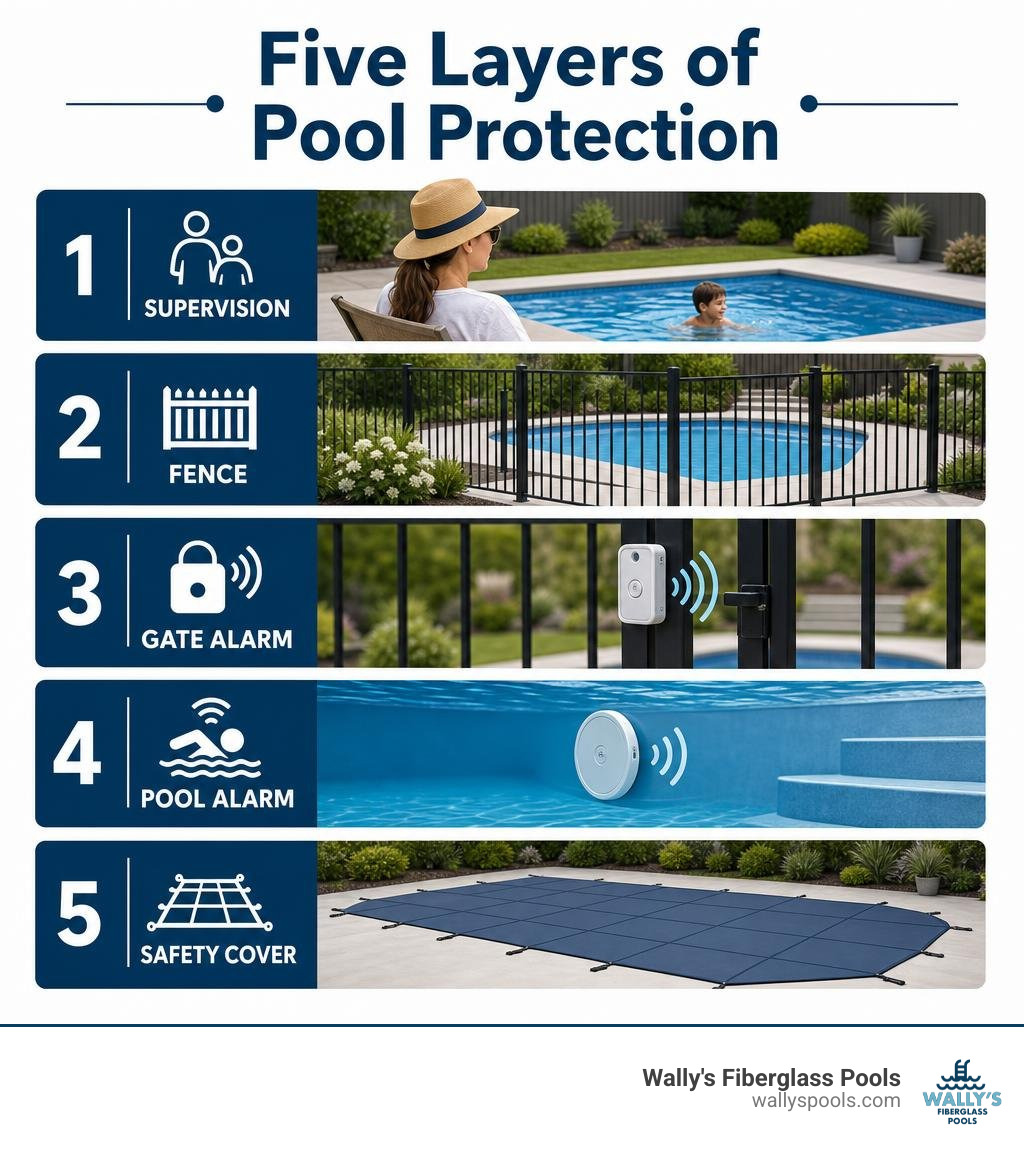
Drowning is the leading cause of accidental death for children ages 1 to 4, and it can happen quietly. An alarm may buy crucial seconds after an unexpected entry, but it is a secondary safety layer – never a replacement for a compliant barrier, locked gate, safety cover, and close supervision.
At Wally’s Pools, we help Southeast Wisconsin homeowners compare practical pool-safety layers that fit real backyards and real weather.
Types of Pool Alarm Systems and How They Detect Motion
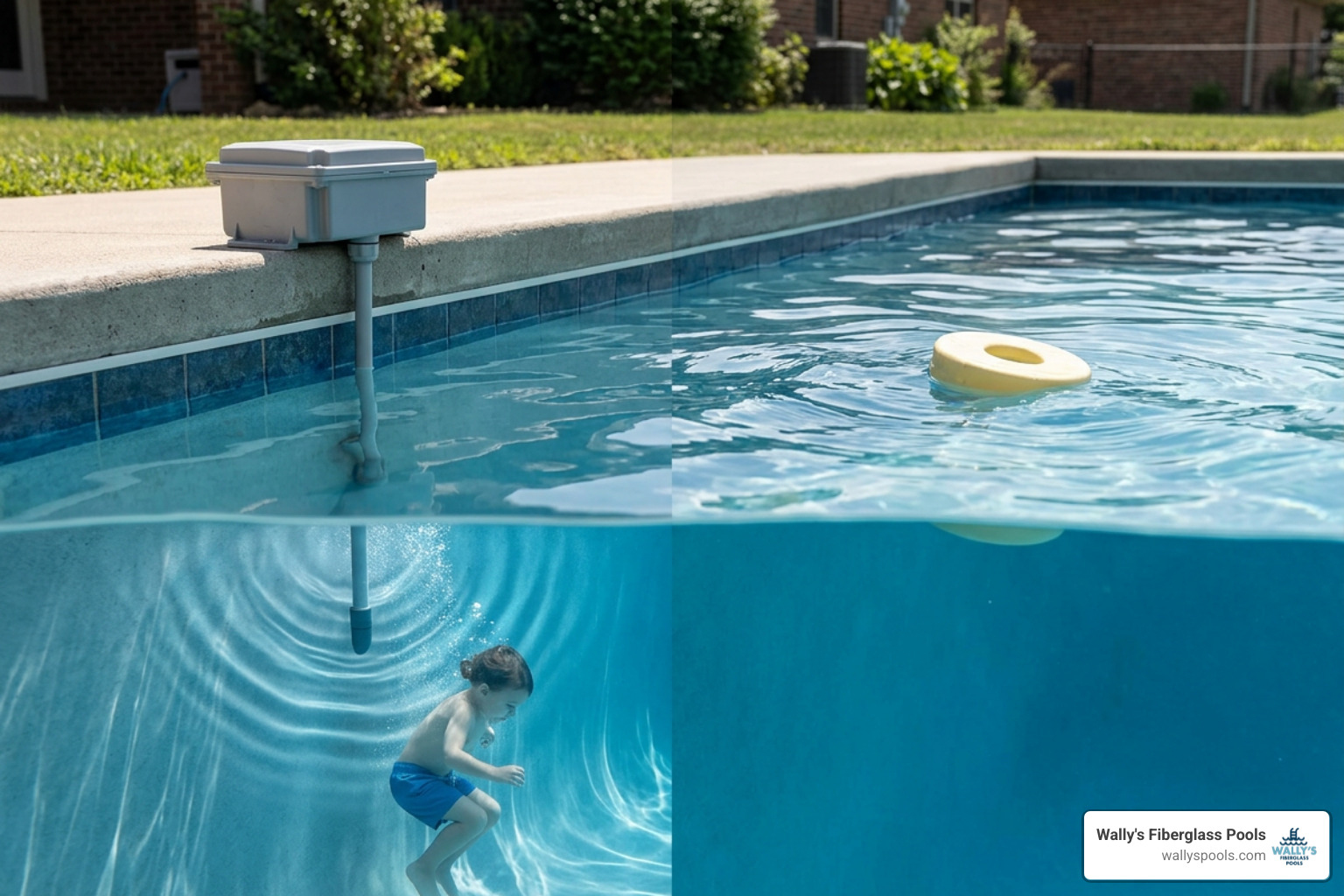
Choosing the right equipment begins with understanding the physics of water displacement. When an object breaches the surface of a swimming pool, it generates two distinct physical phenomena: surface chop (ripples) and hydrodynamic pressure waves traveling below the surface. Different alarm technologies target these zones in distinct ways.
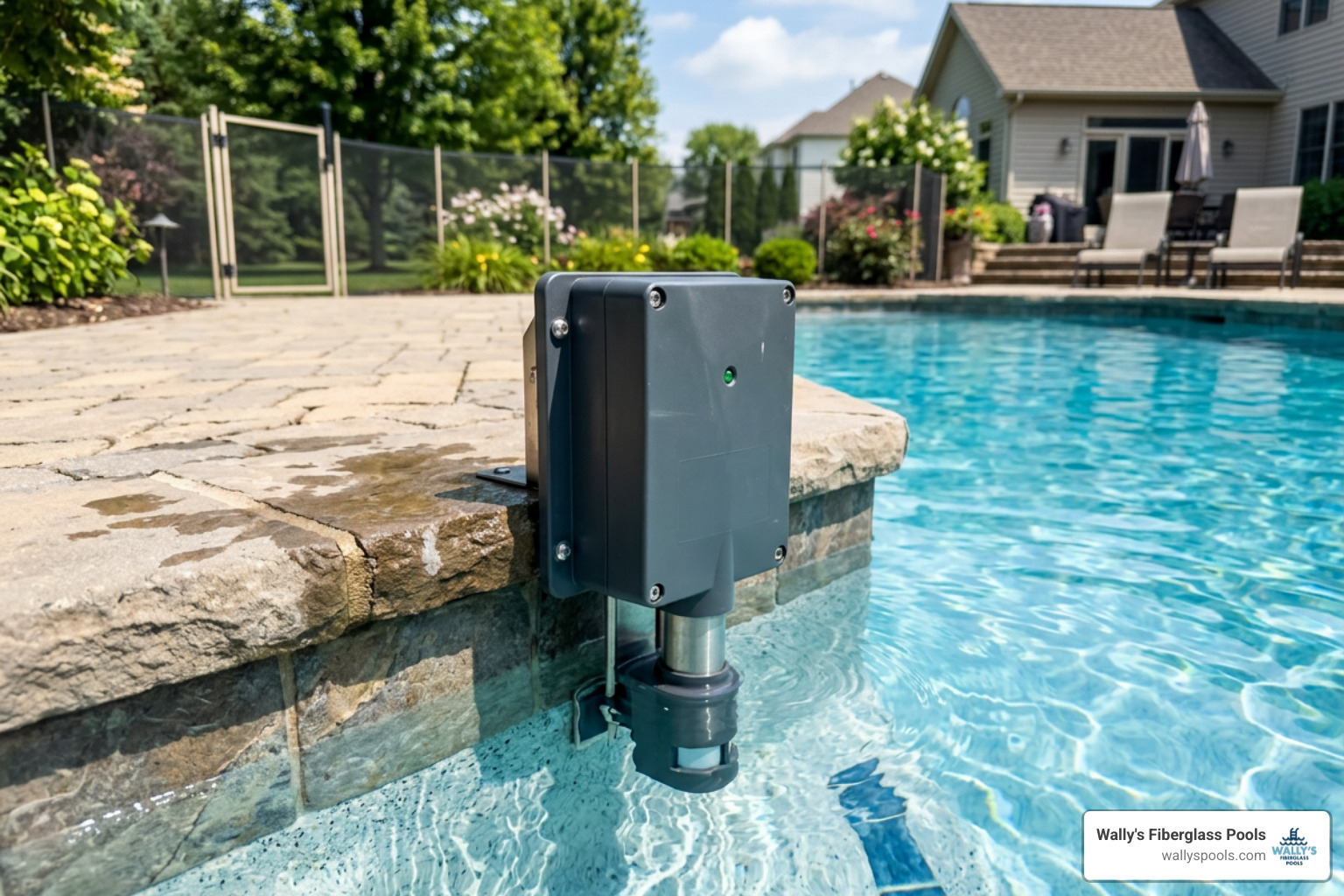
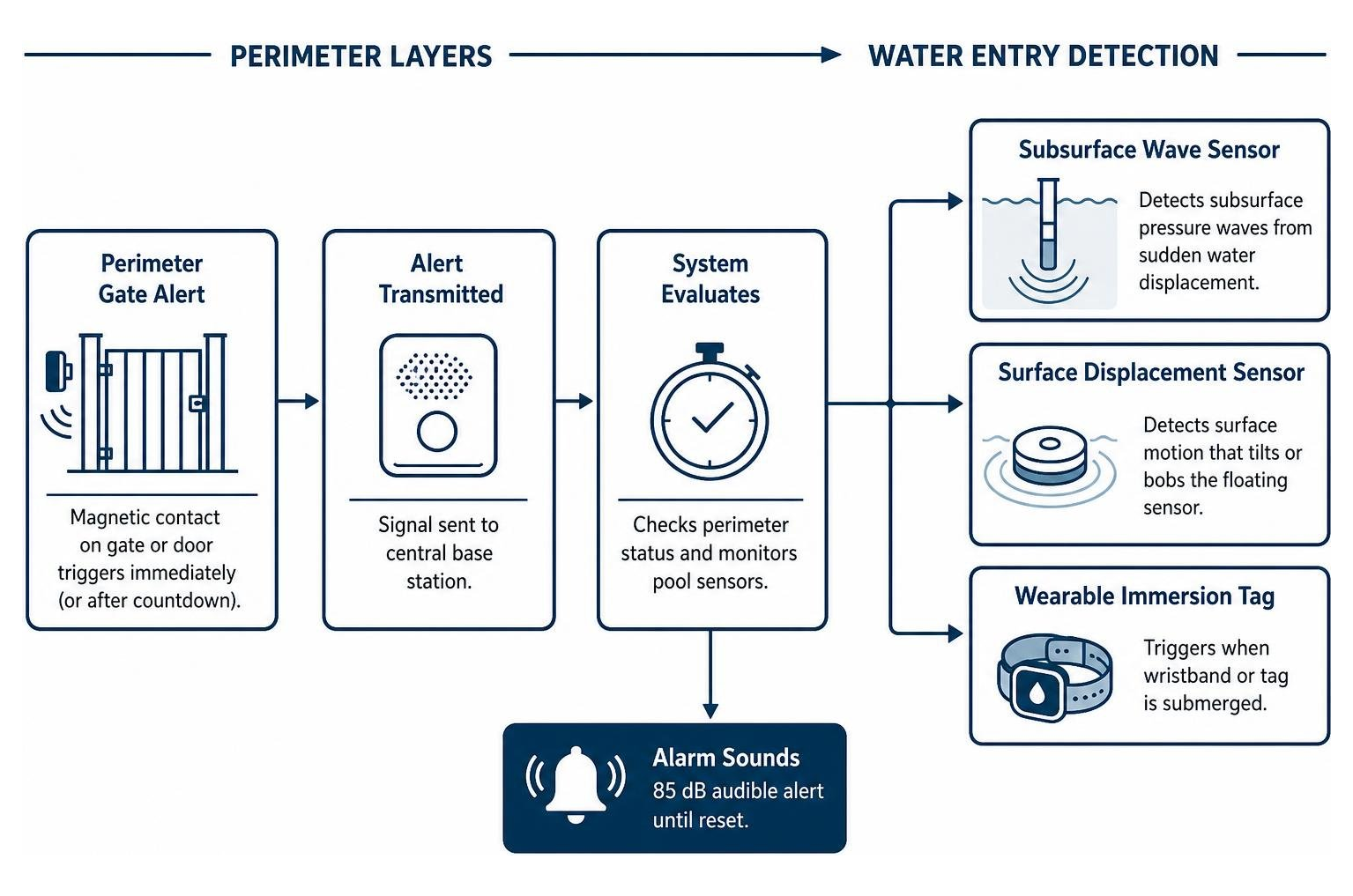
- Subsurface Wave Sensors: Mounted directly to the pool deck or coping, these units extend a sensing tube down into the water. They measure subsurface pressure differentials caused by sudden water displacement while ignoring minor surface ripples caused by wind.
- Surface Floating Displacement Sensors: These devices float freely or tether to the perimeter. They trigger when surface motion tilts or bobs the internal switch past a set threshold.
- Magnetic Perimeter Gate Contacts: Installed on fences and access doors, these magnetic reed switches sound immediately (or after a brief countdown) whenever the boundary is breached.
- Wearable Child Immersion Tags: Wristbands or collar tags worn by children and pets trigger a central base station the moment electrical contacts get submerged.
- Computer-Vision AI Cameras: High-mounted optical systems continuously monitor the pool apron and water volume, distinguishing human presence and abnormal stillness from floating toys or wildlife.
Understanding these operational modes helps pool owners select the right device for their layout. Reviewing the Poolguard operations and safety manual offers a practical look at how physical installation directly dictates sensing accuracy.
Subsurface Pressure and Hydrodynamic Wave Sensors
Subsurface alarms use an internal piezoelectric sensor or mechanical transducer located inside an underwater sensing tube. When a child or pet weighing 18 pounds or more enters the water, the displacement creates an acoustic underwater shockwave.
Because water is virtually incompressible, this pressure wave travels significantly faster underwater than surface ripples do on the top layer. By sampling hydrodynamic pressure variations several inches beneath the surface, these units filter out environmental surface noise like wind, ambient rain, and floating leaves. For reliable detection, manufacturers require mounting the sensor at least 5 inches away from pool walls to avoid acoustic echo interference.
Surface Floating Alarms and Perimeter Gate Sensors
Floating alarms rest directly on the water’s surface, using an internal mechanical float switch or internal accelerometer. When surface chop displaces the unit, the internal circuit closes and sounds the siren. While cost-effective, budget floating sensors can trigger during gusty Midwest summer storms unless they offer stepless sensitivity adjustment.
Perimeter gate sensors take a structural approach. Under UL 2017 standards for residential water hazards, gate sensors monitor access points into the yard. Units like the Poolguard GAPT-2 provide an adult pass-through button, giving adults a 7-second grace window to open and latch the gate without triggering the siren. If the gate remains propped open—or is opened by a toddler—an 85 dB horn sounds immediately.
Key Buying Factors: Certifications, Weight Thresholds, and Accuracy
Safety equipment requires third-party verification. When evaluating models during a new fiberglass pool installation, we check for specific testing certifications:
- ASTM F2208 Standard: The benchmark safety specification for residential pool alarms. It mandates that an alarm detect a simulated child fall (represented by a standardized test mannequin or weight) anywhere across the pool surface within seconds.
- NSF International Certification: Independent laboratory testing verifying that the device meets mechanical durability and electrical safety standards under real-world chemical exposure.
- Audible Volume: Look for a poolside horn producing at least 85 dB at 10 feet, paired with an indoor wireless receiver operating up to 200 feet away.
- Power Management: Reliable units use standard 9-volt alkaline batteries with low-battery chirps that sound every 10 seconds when power dips.
| Alarm Model / Type | Technology | Detection Weight | Certified Standard | Approximate Cost | Installation Complexity |
|---|---|---|---|---|---|
| Poolguard PGRM-2 | Deck Subsurface | 18+ lbs | ASTM F2208 / NSF | $230 – $300 | Moderate (Deck Mount) |
| Lifebuoy BCone | Smart Floating | Variable (App) | Proprietary Motion | $285 – $295 | Very Easy (Tethered) |
| Pool Patrol PA-30 | Floating Buoy | 15+ lbs | ASTM F2208-07 | $190 – $240 | Easy (Surface Float) |
| SwamCam | AI Vision Camera | Visual Presence | ASTM F3698-24 | $495 – $550 | Moderate (Wall Mount) |
| Poolguard GAPT-2 | Magnetic Gate | Access Breach | UL 2017 | $70 – $85 | Easy (Screw / Bracket) |
Performance Breakdown: Leading Safety Models Tested
We reviewed how popular pool alarms hold up to regular household use, examining entry detection, siren volume, and day-to-day usability.
Top-Rated Inground Pool Alarm Systems Evaluated
- Poolguard PGRM-2: Widely recognized for in-ground installations, this unit mounts securely to the coping. It detects water intrusions weighing 18 pounds or more—roughly equivalent to a one-year-old child. It includes an 85 dB siren at 10 feet, an in-home receiver with a 200-foot range, a 3-year manufacturer warranty, and an automatic tamper switch that sounds if someone lifts the unit from the deck.
- Lifebuoy BCone System: A floating system designed for pools up to 20′ x 40′. The BCone links via Bluetooth to a dedicated smartphone app, allowing owners to adjust siren duration and sensitivity. It includes an automatic “Swim Mode” that mutes detection during active pool sessions and re-arms after 10 minutes of still water.
- SwamCam: A vision-based system combining an optical camera with artificial intelligence. Costing around $546, it scans the pool apron, sounding an alarm before a child even touches the water while streaming high-definition video directly to your mobile device.
- MYLO AI Lifeguard: Utilizing an onboard Nvidia processor, this dual-camera setup monitors both above and below the surface, meeting the ASTM F3698-24 computer-vision standard to alert parents if a swimmer stays submerged too long. Review cutting-edge AI drowning detection technology for deeper insight into visual tracking systems.
- Pool Patrol PA-30: A proven buoyant sensor that activates when an intrusion of 15 pounds or more enters the water. Check the Pool Patrol PA-30 specifications for coverage details across larger pool dimensions.
Mounting Configurations and Pool Layout Performance
Sensor placement directly impacts responsiveness. For rectangular pools up to 20′ x 40′ (800 sq. ft.), a single centrally located subsurface unit provides dependable coverage.
For freeform, L-shaped, or oversized pools, acoustic shockwaves can bounce off interior steps or curves. In those layouts, place the sensor away from dead corners and tight alcoves. Always avoid placing subsurface or floating sensors directly adjacent to heavy return jets, bubblers, or cascading waterfalls, which can create localized water turbulence and trigger nuisance alerts.
Installation Protocols, Testing Procedures, and False Alarm Control
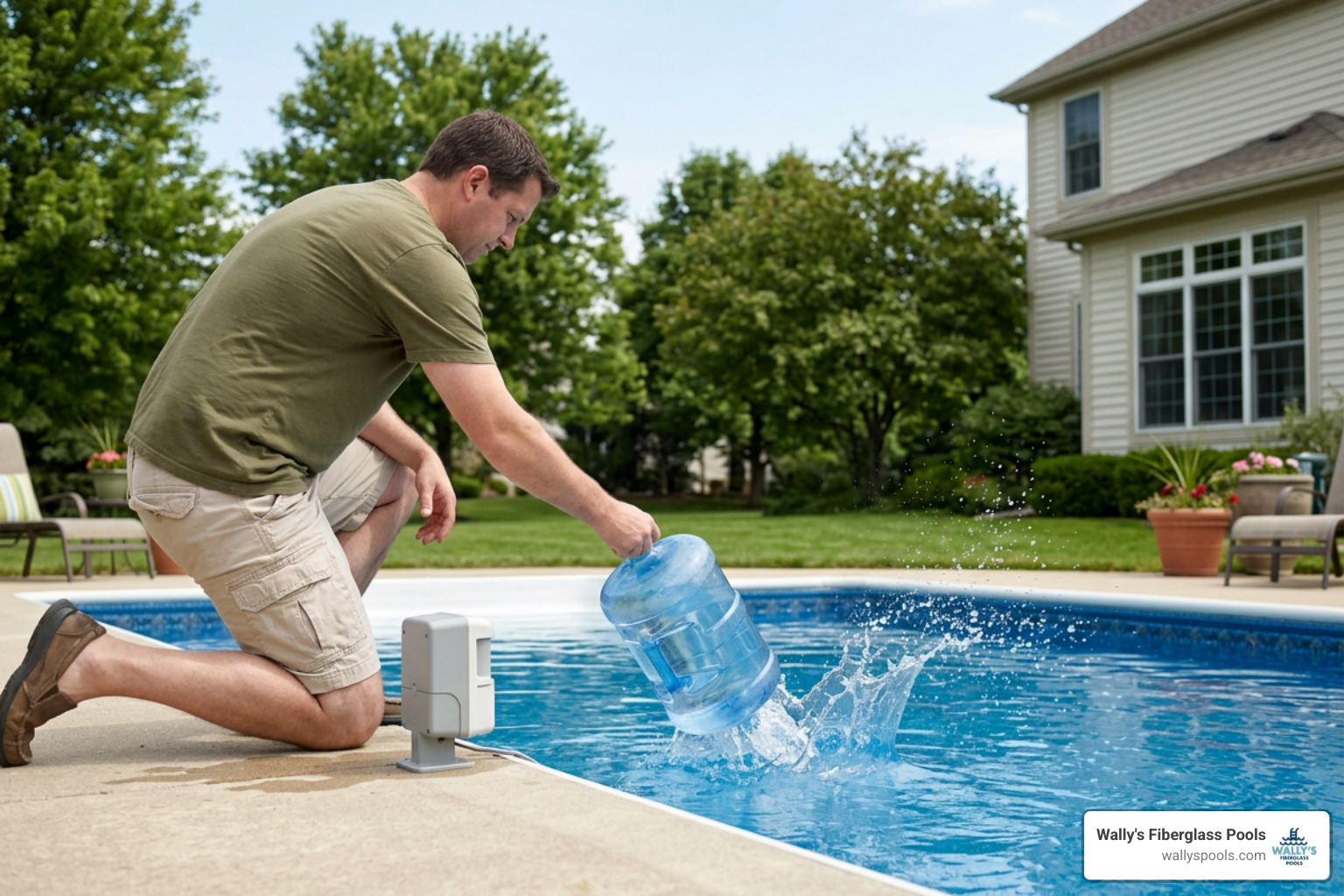
Proper installation makes the difference between a dependable safety tool and an annoying source of false alarms. Follow this operational checklist:
- Mounting Position: Install subsurface brackets on a clean, level section of pool deck coping. Ensure the sensing tube extends straight down into the water without touching the pool shell.
- Return Jet Direction: Point eyeball fittings on your return lines downward toward the floor. Upward-pointing jets create rolling surface waves that disrupt underwater sensors.
- Cleaner Scheduling: Program robotic cleaners and automatic suction sweeps to run during hours when the alarm is set to sleep mode.
- The Drop Test: Calibrate your system using a standard 4-gallon water jug (weighing approximately 33 pounds) or a 2-gallon jug (roughly 16.5 pounds). Drop the weight from deck height at the farthest point of the pool. The alarm should trigger within 3 to 5 seconds.
- Battery Maintenance: Mark your calendar for annual battery swaps using quality 9V alkaline cells.
Keeping your pool shell clean using suitable fiberglass pool cleaning equipment and keeping water levels balanced with regular fiberglass pool maintenance prevents debris and water-line drops from interfering with sensor performance.
Multi-Layer Safety: Integrating Alarms with Backyard Security
A pool alarm is a secondary alert, not a primary barrier. Comprehensive backyard protection relies on overlapping, independent safety layers:
- Perimeter Fencing: A 4- to 5-foot barrier with self-closing, self-latching hinges positioned out of reach of young children.
- Access Door Alarms: Magnetic alarms on any patio or house doors leading out to the pool yard.
- Chemical Lockouts: Store sanitizers, balancers, and shock treatments inside locked, ventilated storage containers away from sunlight and moisture. Review essential pool chemicals to maintain safe storage and balanced water.
- Visual Monitoring: Complement physical alarms with outdoor cameras to keep a visual eye on the pool apron. Learn how smart pool alert systems unify gate contacts and environmental alerts into a single mobile dashboard.
Integrating Smart Pool Alarm Systems with Home Security
Modern safety systems can tie directly into your home’s central security infrastructure. Many standalone receivers feature dry-contact relay outputs, allowing you to hardwire the pool alarm into an auxiliary zone on your main home security panel.
When triggered, the pool alarm sounds its local 85 dB horn while simultaneously flashing your outdoor landscape floodlights, alerting your central monitoring provider, and sending instant notifications to family members’ smartphones.
Frequently Asked Questions About Pool Alarms
What causes false triggers in subsurface pool alarms, and how do I prevent them?
False alarms are usually caused by upward-pointing return jets, heavy wind chop, cascading water features, or automatic robotic cleaners bumping the sensing pipe. You can minimize them by angling return fittings toward the pool floor, turning off decorative water features when the alarm is armed, and adjusting the unit’s sensitivity switch.
Will a pool alarm still work if my pool has a solar or safety cover on it?
Floating displacement alarms generally do not work with solar blankets or winter covers because the blanket restricts surface movement and tangles the float. Subsurface hydro-acoustic alarms can detect pressure changes under certain loose covers, but heavy-duty safety covers require their own perimeter sensors or ASTM F1346-certified anchor straps.
Are pool alarms required by municipal and state residential building codes?
Yes, many jurisdictions enforce specific pool alarm mandates. States like California, New York, Florida, Connecticut, and Tennessee (under the Katie Beth Law) require an ASTM F2208-compliant pool alarm or UL 2017-compliant door and gate alarms when a direct house-to-pool exit exists without an isolating fence. Always consult your local building department for municipal codes.
Conclusion
A pool should be a source of relaxation, family fun, and summer memories. By pairing physical barriers with an ASTM F2208-certified subsurface motion detector, you add an indispensable safety net to your backyard.
Schedule monthly drop tests, replace 9V batteries every spring, and maintain clear backyard rules. For advice on building a safe, durable pool setup designed for Midwest seasons, connect with our team at Wally’s Pools to build your ideal outdoor living space.