Protect Your Gelcoat and Remove Tough Buildup Fast
Best Practices for Cleaning a Fiberglass Pool
Cleaning a fiberglass pool requires gentle tools and mild cleaners to protect its smooth, nonporous gelcoat finish. Use soft nylon brushes, microfiber mitts, and nonabrasive cellulose sponges paired with safe solutions like a 1:1 water and white vinegar mix or dedicated pH-balanced surface cleaners to remove waterline scum, pollen, and body oils. Avoid wire brushes, abrasive scouring powders, and harsh chemicals like undiluted muriatic acid or skimmer trichlor pucks, which cause permanent gelcoat etching and scratches.
Selecting the right fiberglass pool cleaning equipment ensures you remove organic grime and mineral haze without ever risking physical damage to your shell. A quality inground fiberglass pool represents an investment worth anywhere from $30,000 to $80,000. Unlike concrete pools that need replastering every 7 to 15 years, a well-cared-for fiberglass shell never requires structural resurfacing when maintained with proper methods.
| Chemical / Cleaner Type | Safety Level for Gelcoat | Primary Purpose | Potential Risks & Warnings |
|---|---|---|---|
| pH-Balanced Gelcoat Cleaner | Safe | Waterline scum, light mineral film, oxidation | Non-abrasive; rinse completely after use |
| Diluted White Vinegar (1:1) | Safe | Mild calcium waterline rings, surface haze | Effective on light scale without altering pool pH |
| Liquid Chlorine (Sodium Hypochlorite) | Safe | Daily sanitation, shock treatments | Never pour directly against dry gelcoat; disperse evenly |
| Non-Chlorine Shock (Potassium Monopersulfate) | Safe | Weekly oxidation of organics | Does not add unwanted calcium or cyanuric acid |
| Trichlor Tablets in Skimmer | Damaging | Continuous chlorination | Highly acidic (pH 2.8–3.0); etches nearby gelcoat |
| Calcium Hypochlorite (Cal-Hypo) | Damaging | Pool shock | Adds calcium carbonate; leads to cloudiness and scaling |
| Muriatic Acid (Undiluted on Gelcoat) | Damaging | Stain removal attempt | High risk of chemical burns, permanent etching, and blistering |
| Abrasive Scouring Powders | Damaging | Tile or stain scrub | Scratches smooth gelcoat permanently; invites algae |
Safe Tools for Cleaning a Fiberglass Pool
Think of your pool’s gelcoat just like the clear-coat finish on a high-end car: you would never take a wire brush or coarse sandpaper to your car’s paint job. The exact same principle applies here.
To keep your shell pristine, outfit your maintenance caddy with:
- Soft Nylon Bristle Brushes: Nylon provides enough flexibility to dislodge clinging organic films without abrading the surface.
- Foam and Microfiber Brushes: Ideal for routine waterline wipes and delicate step transitions.
- Nonabrasive Cellulose Sponges or Microfiber Mitts: Perfect for manual scum line wipe-downs along the perimeter.
- Telescopic Poles with Rounded Plastic Caps: Always ensure the pole ends are capped so bare metal never bumps or scrapes the steps.
- Automatic Cleaners with Soft Rubber Rollers: Ensure any robotic or suction cleaner uses rubber wheels and soft brushes rather than stiff plastic scrubbers.
Inspect your pool brushes each season. Over time, plastic brush blocks can degrade in sunlight, exposing sharp corners, and bristles can turn brittle. Replacing your basic pool brush every year or two is an easy $15 to $30 step that prevents thousands of dollars in gelcoat repairs.
Safe Cleaners and Chemical Compatibility
The nonporous nature of gelcoat makes cleaning much easier because contaminants sit on the surface rather than sinking deep into porous plaster. Most weekly waterline grime yields quickly to mild solutions.
A simple 1:1 mixture of water and white distilled vinegar is one of the safest home remedies for light mineral scale. For greasy scum rings made of suntan lotion, hair products, and natural body oils, use specialized pH-balanced pool surface cleaners. These break down oils quickly without leaving soapy residues that disrupt your water balance.
Avoid all abrasive scouring powders, wire brushes, steel wool, and industrial-strength solvent cleaners. According to the manufacturer pool care guide, using harsh industrial chemicals or rough scouring pads can instantly void your gelcoat surface warranty. Stick to products specifically formulated for swimming pool gelcoats and acrylic hot tubs.
Step-by-Step Gelcoat Stain and Scum Line Removal
A dark or chalky waterline ring is the pool equivalent of a bad hair day—it looks messy, but it is completely manageable with a clear game plan. Waterline rings form when sunscreen, environmental pollen, and atmospheric dust combine with fluctuating water levels and dry against the sun-baked upper perimeter of your pool.
Staying on top of this buildup with routine fiberglass pool maintenance keeps organic matter from baking hard in the summer sun.

Waterline Scum Line Cleaning Process
Cleaning your scum line only takes about 10 to 15 minutes during your normal weekly pool routine. Follow these actionable steps:
- Lower the Water Level Slightly (Optional): If you have a wide band of dried buildup, lowering your water level 1 to 2 inches below the normal skimmer midpoint gives you dry access to the ring.
- Apply a Safe Gelcoat Cleaner: Shake your specialized fiberglass pool surface cleaner thoroughly. Spray or sponge the cleaner directly onto the affected scum line in manageable 4-to-6-foot sections.
- Allow Dwell Time: Let the solution sit on the surface for 30 to 60 seconds (or up to 5 minutes for stubborn residue, depending on the product label). This dwell time softens the oils without drying out.
- Wipe Gently with a Soft Sponge: Use a nonabrasive sponge or soft microfiber cloth to wipe the scum away in overlapping circular motions. Avoid excessive pressure; let the cleaner do the heavy lifting.
- Rinse Thoroughly: Rinse the treated section immediately with fresh water from a garden hose or clean pool water.
- Brush Down into Filtration: Use your soft nylon wall brush to sweep any dislodged floating dust toward the skimmers so your pool filter captures it.
Treating Metal Stains and Oxidation
If you notice yellow, brown, reddish, or turquoise stains rather than a greasy scum ring, you are likely dealing with metal oxidation or mineral deposits rather than organic grime. Iron from well water produces rust-colored or yellow hues, while copper leads to teal or blackish staining.
Fiberglass finishes can also develop a dull, chalky surface haze known as oxidation when exposed to intense UV rays and out-of-balance pool water.
- Treating Metal Stains: Do not scrub metal stains with brushes. Instead, add a high-quality metal sequestering or chelating agent to your pool. These liquid agents bind to suspended iron, copper, and manganese ions, holding them in solution so they cannot oxidize and bond to the gelcoat. For best results, dose your pool with a stain and scale preventer quarterly at a rate of roughly 1 quart per 10,000 gallons.
- Removing Surface Oxidation: If your gelcoat looks chalky or faded above the waterline, apply an acrylic- and gelcoat-safe polish or specialized fiberglass cleaner. Apply with a clean microfiber pad, allow it to break down the oxidized layer, wipe off the residue, and buff lightly to restore the original deep luster.
Water Chemistry Management for Gelcoat Protection
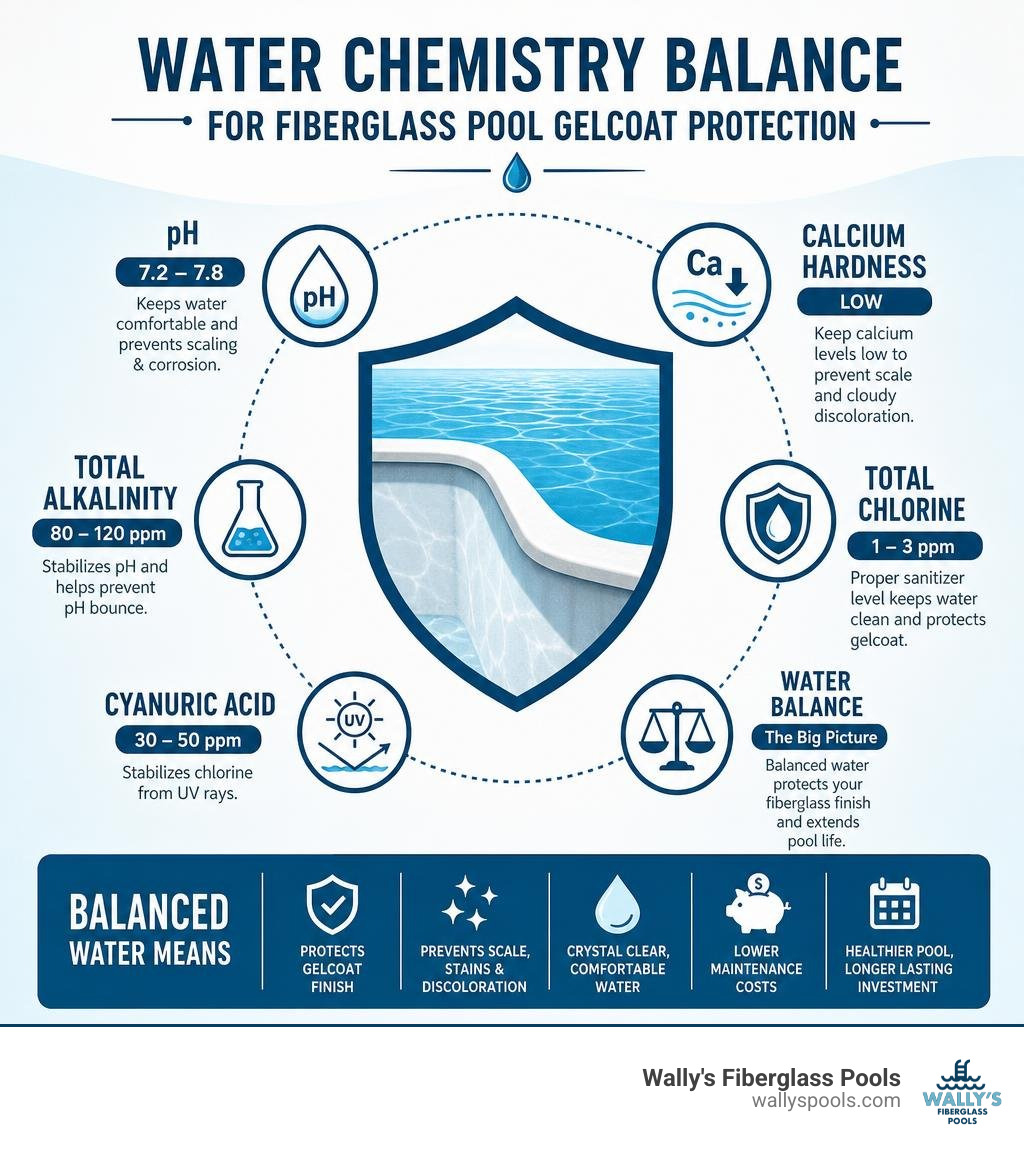
Maintaining clear, balanced water is about more than just swimmer comfort—it is your front line of defense against surface discoloration. Keeping the proper balance of pool chemicals ensures that dissolved minerals remain safely in solution rather than dropping out as rough scale on your pool walls.
Many homeowners do not realize that standard water balance guidelines were originally engineered for concrete and plaster pools. Plaster pools contain high amounts of calcium and rely on saturated water to keep the plaster from dissolving. In contrast, fiberglass pool shells contain zero calcium. Because of this fundamental difference, standard plaster-focused maintenance guidelines can quickly ruin a fiberglass finish, as noted in practical pool maintenance guidelines.
Calcium Hardness and pH Balance
Calcium is the root cause of the vast majority of surface discoloration and scaling issues on fiberglass pools. When your pool’s pH, alkalinity, or temperature climbs while calcium levels are elevated, calcium carbonate precipitates out of the water, settling onto your smooth gelcoat as a sandpaper-like crust or cloudy white discoloration.
At lower calcium levels, your fiberglass gelcoat tolerates a much wider range of pH and chlorine fluctuations without staining or scaling.
| Chemistry Parameter | Ideal Target Range for Fiberglass | Plaster Comparison | Why It Matters for Gelcoat |
|---|---|---|---|
| pH | 7.2 – 7.4 (Max 7.6) | 7.4 – 7.6 | Prevents scale precipitation and maximizes chlorine efficiency |
| Total Alkalinity (TA) | 80 – 120 ppm | 80 – 120 ppm | Buffers pH against sudden, drastic swings |
| Calcium Hardness | Under 120 ppm (or 200–275 ppm max) | 200 – 400 ppm | Fiberglass requires no calcium; lower levels eliminate scale risk |
| Free Chlorine | 1.0 – 3.0 ppm | 1.0 – 3.0 ppm | Sanitizes water while preventing organic staining |
| Cyanuric Acid (CYA) | 30 – 50 ppm | 30 – 50 ppm | Shields chlorine from UV degradation |
| Langelier Saturation Index (LSI) | -0.30 to +0.30 | -0.30 to +0.30 | Balanced index ensures water is neither corrosive nor scale-forming |
| Total Dissolved Solids (TDS) | < 1,500 ppm (Salt: up to 2,500 over salt baseline) | < 2,000 ppm | Prevents mineral haze and dull pool surfaces |
Keep a close eye on the Langelier Saturation Index (LSI), which measures water saturation based on pH, temperature, calcium hardness, alkalinity, and TDS. Maintaining your LSI between -0.30 and +0.30 guarantees that your water will not leach minerals or drop scaling deposits on your finish.
Chemical Delivery Methods When Cleaning a Fiberglass Pool
How you introduce sanitizers into your water is just as critical as the chemical amounts you measure out. Improper delivery methods can create concentrated zones of extreme acidity or intense calcium that leave permanent marks on your gelcoat.
- Liquid Chlorine is Best: Sodium hypochlorite (liquid chlorine) is our top recommendation for fiberglass pools. It dissolves instantly, leaves no granular residue on the floor, and adds zero calcium to your pool.
- Avoid Calcium Hypochlorite (Cal-Hypo): Cal-hypo shock introduces unneeded calcium with every single dose. In hard-water areas like Southeast Wisconsin, repeated cal-hypo use pushes calcium hardness into dangerous territory, causing scale formation and cloudy water.
- Never Drop Trichlor Tablets in Skimmers: Trichlor pucks are exceptionally acidic, with a pH of 2.8 to 3.0. When your pool pump turns off overnight, tablets sitting in a skimmer basket create a super-concentrated pool of acid. When the pump turns back on, that acidic wave washes through the return lines, etching and dulling the gelcoat around return jets and skimmer mouths.
- Use Inline Chlorinators or Floating Dispensers: If you use chlorine tablets, always place them in an off-line erosion feeder or a tethered floating dispenser that stays away from shallow steps and ledges.
- Use Non-Chlorine Shock for Routine Oxidation: Potassium monopersulfate breaks down organic oils, sweat, and sunscreen without spiking chlorine levels or adding calcium hardness.
Frequently Asked Questions About Fiberglass Pool Care
What is the best way to clean a scum line on a fiberglass pool?
The safest, most effective way to remove a scum line is by using a dedicated pH-balanced fiberglass pool surface cleaner or a 1:1 mixture of water and white distilled vinegar. Apply the cleaner directly to the scum line using a soft microfiber cloth or nonabrasive sponge. Let the solution dwell on the buildup for 30 to 60 seconds to break down dried oils and body lotions, gently wipe the surface in circular motions, and rinse clean with pool water or a garden hose. Make soft nylon brushing of the waterline a regular weekly habit to stop stubborn mineral rings from ever forming.
Why should calcium hypochlorite be avoided on fiberglass?
Calcium hypochlorite (often sold as basic granular pool shock) adds significant amounts of calcium directly into your pool water with every application. Concrete and plaster pools need calcium to keep water from eroding their plaster, but fiberglass shells contain no structural calcium. Adding cal-hypo raises calcium hardness levels unnecessarily, which quickly leads to surface scaling, cloudy water, and gray or white discoloration on the dark, glossy gelcoat. Liquid chlorine and non-chlorine shocks provide superior sanitation without risking calcium scale.
How often should fiberglass pool chemistry be tested?
You should test your pool water chemistry at least once a week during the active swimming season. Test for free chlorine, pH, and total alkalinity weekly, and adjust promptly to keep pH steady between 7.2 and 7.4. Calcium hardness, cyanuric acid (stabilizer), and total dissolved solids should be tested once a month. In addition, run a comprehensive water test after severe rainstorms, heatwaves, or high-capacity pool parties to ensure your water stays properly balanced.
Conclusion
Protecting your fiberglass pool gelcoat does not require hours of heavy scrubbing or harsh industrial acids. By relying on soft nylon tools, applying pH-balanced cleaners for waterline scum, maintaining lower calcium hardness, and avoiding acidic skimmer pucks, you can easily preserve your pool’s smooth, glossy finish for 15 to 20 years or more.
If you ever run into stubborn metal stains, heavy scale buildup, or need regular equipment service in Waukesha or Milwaukee County, our experienced team at Wally’s Pools is ready to help. Schedule a visit through our professional fiberglass pool service page or explore our full range of custom inground installations and seasonal maintenance solutions at Wally’s Fiberglass Pools. We build and maintain durable backyard retreats designed to withstand Midwest weather and provide your family with decades of worry-free enjoyment!